Wednesday, April 22, 2015

More on Father Pierre Paris as MEP Father and constructor of the church

Born 19 of Jan 1833, Father Pierre Paris was born 50 years before the birth of first parish priest Father Michael Seet in 1883.

He was attributed to be the constructor of the St Peter and Paul church in 1870.

As the MEP and also parish priest, he was distinctly unique amonst others as he could speak Tamil!

Father Pierre Paris was able to traverse between town area(which is Queen Street) and also the jungles in Serangoon.

As the times were tough for any MEP priests, having faced competition from the gangsters and triads, nevertheless the work of evangelism carried through assimilating cultures and language. He learn the vernacular of the early immigrants, which were Teochew and Hokkien and made them feel comfortable.

In fact for the MEP priest, life was often beset with problems of society at that time, namely poverty and gangsterism.

One of the triad leaders called an MEP Father who lived around the same time,  Father Albrand,  "the Head of the Devil  and threatened to cut off parishoners pig tails when they tried to convert.  Serangoon (Ao Kang) was a jungle and so was Bo Chu Kang. However these were Catholic enclaves. They were united by their faith, they though in different parts of Singapore.  In 1853 a small chapel was erected and blessed in Serangoon(called St Mary's and later renamed Nativity Church).
Father Pierre from the heart of  town,  had to travel by foot, to these areas to say Mass and interact for the pastoral needs of the Indians and other settlers on the outliers of the island.

The jail was in the town area too. Father Pierre had to say mass at the prison. The jail was called by British colonial Bras Basah Jail (the local Chinese called it "Lau Ka Ku Keng Kau")  (Map is appended below).  This rhythm of life of servanthood, and pastoral care is continued by the priests till today with priests saying in our jails albeit in highly restricted grounds of  Changi.


Father Pierre Paris had very close ties with the cathechists and the cathechumans. Father Pierre Paris received much support through large donations by a Pedro Tan No Keah to build the church of St Peter and Paul. Later, houses for cathechists were built by Chan Teck Hee.

Father Pierre also set up the St Francis Malabar school located along Waterloo Street.

It could be clearly seen  with his grasp of the Tamil language, and his closeness to his flock, he influenced the outcrop of the next church he was to build Church of Our Lady in 1888, seventeen years after he built St Peter and Paul. The church was to house the Tamil worshippers, a footprint of Father's Pierre no doubt in early development of the first Singapore Catholic churches.

http://eresources.nlb.gov.sg/infopedia/articles/SIP_100_2005-01-24.html

http://www.microsite.nl.sg/pdfs/biblioasia/biba_0304jan08a.pdf


http://www.ghettosingapore.com/story-of-the-old-bras-basah-jail/


The old Bras Basah Jail is clearly marked as a convict jail as seen in this old map. Image courtesy of National Museum of Singapore.

Tuesday, April 21, 2015

The Teochew and Hokkien church amidst other Christian Churches

In 1916, 5 years after the ordination of first local priest Father Micheal Seet, was a hub of Christian activity.

The St Peter and Paul church was known affectionately as the Teochew and Hokkien church.

Below were the churches with services on May 14(3rd Sun after Easter)
published in the Singapore Free Press and Mercantile Advertiser on 13 May 1916:

Bethesda Bras Basah Road
3 services 9am, 4pm and 8pm
Prinsep Street Baba Church
3 services 8,9 am and 745pm
Wesley Church Fort Canning Road
3 services 8,9 am and 530pm
Middle Road Church
3services 10,11am and 730, 8pm
Presbyterian Church Orchard Road
8,9am
Boustead Institute
815pm
St Peter's church Stamford Road
930am,2, 4pm,730pm,
Chinese Christian Church
930am, 2,730pm
St John's Church Jurong
9am
Cathedral of Good Shepherd
515am,8am,5pm
Church of St Peter and Paul
530am,
Church of our Lady

Seventh day Adventist chapel


more on Father Becheras , renowned MEP priest in St Peter and Paul whose influence continue on today


A Statue of Father Becheras in
front of the clock Tower of Catholic
High School with a High School
and Primary School student.


Father Becheras contribution included Parish Priest of St Peter and Paul Church. It was said that when he wielded a cane and went on to find his lost sheep, parishioners who indulged in vices and were seen in places that included vice and prostitution.

Father Becheras other contributions included building the Catholic High School in 1935 at Queen Street opposite the St Peter and Paul church. Father Becheras taught science which was uncommon at that time, and he had the vision to run it as a bilingual school. Not surprisingly the enrolment gre rapidly and within 2 years, the school had to expand. (Today the first school campus houses 8Q Singapore Art Museum).


Above, a statue of Father Edward Becheras is placed at the Catholic High school in memory of his work done to Singapore.

http://en.wikipedia.org/wiki/Catholic_High_School,_Singapore


http://en.wikipedia.org/wiki/Catholic_High_School,_Singapore#/media/File:Catholic_high_school_002.jpg

MEPs and their mission, and formation of seminaries for training priests

The MEP Fathers which hailed from Paris and started their mission from the outcrop of Siam, and subsequently to Malaya and Singapore, finally established a base in Penang, where first churches were built, and spread their evangelization efforts down to Singapore with first seminary in 1849 in Punggol.

However it was moved back to Mata Tinggi as Bishop Bucho wanted to keep an eye for expedience sake as Singapore was too far. A remnant of the plague is found in Punggol titled St Mary's College.

Indeed the roots of seminary had its incipient stage in Singapore as early as 1849, but due to lack of funds, and probable change of decision owing to consolidation factors, and funding under Bishop Boucho, it very much later in 1920s restarted when Bishop Barillon built a seminary here. It closed during the Japanese War and was reopened later under Father Pierre Barthoulot , another MEP.


 http://www.sfxms.org.sg/articles_barthoulot.html


 http://eresources.nlb.gov.sg/infopedia/articles/SIP_831_2005-01-03.html


In  Fr Pierre Barthoulot(MEP) , who restarted the first seminary in Singapore, 

I became a priest because I wanted to be a missionary. In my family, every generation produced a priest. I did not want to stay in the parish. I was born in Eastern France, near the Swiss border, there were 1,000 priests in the diocese. I chose a society which sent their priests to Asia, so I joined the MEP. I did not ask to come here but I was sent. I did not ask to be assigned to the seminary because I never thought that I would be the right man for the seminary but I was there for 25 years.

 
When you obey God through your superior, you don't make mistakes. There is a reflection I wrote regarding my priesthood: “To obey is not enough to do what obedience commands. It is necessary to do it without reasoning about it. Be convinced that whatever is commanded is the best thing that can be done. We are naturally inclined to command and often unwilling to obey. Yet it is certain that to obey is more advantageous that to command."
 
The earlier MEPs starting from Bishop Boucho, then Bishop Barillon, had given the seeded the idea of a seminary in Singapore. Through tumultuous times, like Japanese War, it finally bore fruit. Today because of the works of the MEPs, we have locally trained diocesan priests.
 
In fact the first local priest from a religious order when Father Pierre Barthoulot arrived was Father Paul Pang, as during the early priests who took part in pastoral activity were mainly MEPs. Tough from a missionary order, they took orders from the local bishop. Religious priests on the other hand can follow the charism of their order.  Because of the flurry of activity, today there are many religious orders. They helped to establish the clergy I Singapore, leaving us in good hands. Today we have our own seminary in St Francis Major Seminary, thanks to the MEPs works. Added to that we have many locally trained diocesan priests.
 
St Peter and Paul was blessed to have Father Michael Seet Kiam Juay the first local born diocesan priest trained in the seminary founded by the MEPs in College General in Penang, with roots tracing back to 1665.


First rector of Minor seminary in Singapore
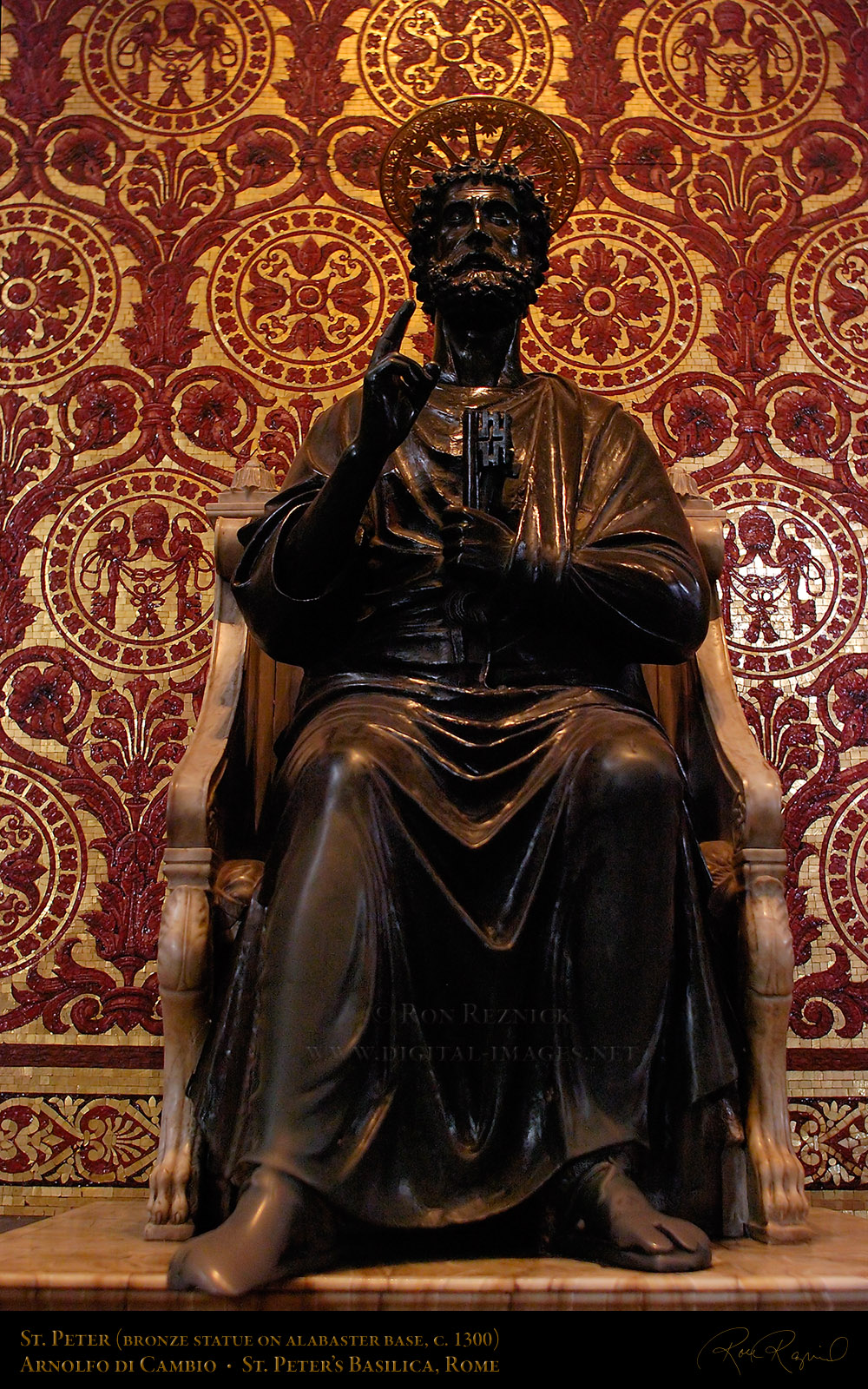


St. Peter statue in the church

The St Peter Statue in St Peter and Paul church resembles the one in the St Peter's Basilica in Rome.

It was designed by the artist Arnolfo di Cambio’s sculpture of St. Peter, c. 1300.  this highly venerated sculpture of St. Peter is seated on an alabaster throne. His right foot protrudes from the base.

In flowing robes, he pictured holding the keys to heaven.

The statue has long been regarded as having been created in the 5th century, commissioned by Pope Leo I (440-461).

Interestingly, except with the halo, St Peter which has the unique feature of has curly beard and hair and the statue in St Peter and Paul Singapore clearly draws from the one in Rome and attributed to the artist Arnolfo.

Also its historicity dates back much longer as it was commissioned by Pope LeoI in the 5th Century.
A comparison of the statue found in Singapore and Rome is found below.

http://www.digital-images.net/Gallery/Scenic/Rome/Churches/StPeters_Int/stpeters_int.html

http://blog.omy.sg/jerome/2013/05/24/the-chinese-church-%E2%80%93-another-national-monument-in-need/
The statue of St. Peter at the entrance.


StPeter_7655M

Monday, April 20, 2015

Father Emile Joseph Mariette of St Peter and Paul Church who also went on to build St Theresa church


Reverend Father Emile Joseph Mariette was Vicar of Church of Saints Peter and Paul from 1908 to 1928. His contribution did not end there.


The MEP father did not stop there. Later he set about building St Theresa built the church of St Theresa in 1923. The church was established in 1929.

Indeed the St Peter and Paul influence amongst early churches was profound.


Portrait of Reverend Father Emile Joseph Mariette, Vicar of Church of Saints Peter and Paul

Chan Teck Hee who was also one of the important donors of St Peter and Paul assisted in donating 5 more bronze bells to Father's Emile Joseph mission at the new church. He named it after his five children, and will string a chord when rung.


This MEP father was an example of the MEP priests in Singapore who took the efforts to learn the dialects which included Hokkien and Teochew languages. This enabled them to communicate and catechize to the parishioners and their family members as well as early community.


He also officiated in the pontifical High Mass for the first local born priest Michael Seet in 1911.


http://eresources.nlb.gov.sg/infopedia/articles/SIP_1704_2010-08-16.html

http://eresources.nlb.gov.sg/printheritage/image.aspx?id=c8a952cb-b2a4-4d5d-b239-b2fb41f68ac8

http://eresources.nlb.gov.sg/newspapers/Digitised/Article/straitstimes19280314.2.41.aspx
http://www.sfxms.org.sg/articles_barthoulot.html


The first local born Priest in St Peter and Paul and the first founding fathers of St Peter and Paul

Father Michael Seet had the honour to be the first local priest in Singapore and he was the first local born priest to serve in St Peter and Paul church.

He was ordained in 1911 when Singapore had no seminary yet.

In those days, the seminary was in college general in Penang as the MEPs developed a base there for missionary works in this region. The seminary was run by the MEPs.

Father Michael Seet had studied there for 12 years. He was ordained by Bishop Emile Barrilon and concelebrated by Rev Fathers Emile Joseph Mariette(Master of Ceremony) , Father Duvelle, and Father G. Chevauche(all MEP Fathers).

In 1911, Bishop Barillon was overseer in Malacca and Singapore. Father G Chevauche was the first to erect the first church, a plank chapel, in Kampar, and an outstation of mother church St Joseph in Penang under Barillon, Bishop of Malacca. It was blessed and officiated by Bishop Barillon.

The other priest that later were locally born and ordained were Stephen Lee and Rudolf de Souza in 1922.

Notably Father Michael Seet, was the second son of cathechist Seet Twa Tee. He had been a cathechist for 30 years. He lived in the house next to the church, and these houses had been erected after Chan Teck Hee, the famous donor to the church, director of Sze Tong Hai bank and Kiam Hoa Heng Co Bangkok, purchased the plot and build hoses for the Cathechists, the widows and the aged.

In 1911, the year Father Michael Seet was ordained, there were indeed 5 parishes only, namely, the Cathedral of Good shepherd, St Peter and Paul, Our Lady of Lourdes, and St Joseph Church(Bukit Timah) with priests linked to the MEP with the fifth from St Joseph church(Of which St Joseph church belonged to Portugese mission) and Catholics numbered

The first founding Fathers of St Peter and Paul were Father Issaly and Father Pierre Paris.

Father Michael Seet died at the age of 63 on 18 June 1946, and was buried at Bidadari Cemetary.

http://eresources.nlb.gov.sg/newspapers/Digitised/Article/straitstimes19280314.2.41.aspx
http://www.penangdiocese.org/wp-content/uploads/2012/09/spSHJ.pdf
http://eresources.nlb.gov.sg/newspapers/Digitised/Article/singfreepressb19300910.2.47.aspx


Sunday, April 19, 2015

The stained glass in the middle of the church

Interestingly , St Peter and Paul also has a stained glass right in the middle of the church depicting Our Lady of Lourdes. Yes whilst in the publication of the book for the Lady of Lourdes there is but one Lady, the devotion evidently during the second half of 1850s to this special Lady, came from St Bernadette of Lourdes where our Lady appeared. Indeed it was on 11 Feb 1858 that our Lady of Lourdes appeared to St Bernadette revealing herself as the Immaculate Conception, ie that Mary was born without original defilement or sin; She was truly immaculate. To prove this. miracles took place at Lourdes. A spring of water where she appeared flowed and till this day many pilgrims are healed. It is a place of refuge and comfort and healing, spiritually and physically. This coincides very strongly that perhaps to cater to this very strong devotion our Lady of Lourdes in Ophir Road Singapore was built in 1888 shortly after St Peter and Paul in 1870. It is also because this fact that is why the stained glass in St Peter and Paul right in the middle with prominence was given our Lady of Lourdes. Coupled with this is the strong rosary devotion, undergirded by efforts of Rosary pope Leo XIII which saw the unearthing of broken rosaries under the Cathedral of Good shepherd built in the 1850s. In this another unbroken rhythm of the Catholic Church life in Singapore, our Lady of Lourdes is still celebrated till this day in the Indoor Stadium. On 6 Dec 2014, the Lourdes Experience was held in Singapore for the third time preceding one law being held in 2004 and 2008. It commemorated the 160th anniversary of the dogma of the Immaculate Conception, and the 150th anniversary of the appearance of Our Lady of Lourdes to St Bernadette, conforming church teachings and being a source of joy, comfort and healing to many infirmed. It is remarkable that St Peter and Paul has a stained glass in honour of our Lady when it was built in 1870, which led to Lady of Lourdes church in 1888 and even St Bernadette church in Singapore at Zion Road built in 1958 in what can also be seen as another unbroken rhythm that is linked from early Singapore church history to present day and the blessings of Our Lady. Lennard at 1:43 PM

Friday, April 17, 2015

Some important historical people St Laurent Imbert and Father Beurel and Father Becheras MEPs leading to St Peter and Paul

St Laurent Imbert was born 1796. The MEP order started in The starting point of missionary began in Siam during 1658. Based there, the Siamese King supported the seminary of St Joseph. It was revitalized by Napolean in 1805 but due top a dissent with the Pope, and again under LouisXVII in 1815. In 1839, St Laurent Imbert became Apostolic Vicar of Korea. However as Russian war ships came and demanded trading rights and residency from Korea , the latter allied with French and brought forth French MEP priests like St Imbert. Finally they were massacred for their faith. His travels took him to Malaya Peninsula. St Laurent Imbert came to Singapore in 1821 before proceeding to Korea. He was the first to be martyred along with 3 others in Korea in 1839 for the faith. Later the oldest church in Singapore was named The good Shepherd, as they remembered him as "the good shepherd lays his life for his flock". In 1984 Pope John Paul the 2nd canonized him and 103 other martyrs. The second oldest church St Peter and Paul arose from the efforts of the same missionary house that St Laurent Imbert came from. Instrumentally helped in big way by Father Beurel, who also an MEP priest, who built the SJI and CHIJ (1st Catholic schools in Singapore) and thereafter, helping to build the Cathedral of Good Shepherd and St Peter and Paul church. His era which marked the first phase of MEP activity in Singapore, came to an end around in 1872 when he died. Leaving us in good shape. Instrumentally, he brought in only 6 sisters and 4 brothers(one sister died on the ship) and that spread the missionary zeal in Singapore. He was also known as founding Father of Catholicism in Singapore, due to his untiring efforts. He also helped build the mother church and the first three churches Church of St. Peter and Paul along Queen Street, the Church of St. Joseph in Bukit Timah and the Church of the Nativity of the Blessed Virgin Mary in Upper Serangoon Road. From the period of 1872 onwards just after St Peter and Paul was built in 1870, leaving good institutions and momentum in its wake, Father Becheras continued to soldier on. After he became parish priest of St Peter and Paul. As Vicar General of church in Serangoon, he continued to develop the northen side of Singapore in Serangoon area and Hougang restarting Holy innocent school and initiating bilingualism and serving the church. He died in 1957. http://www.patheos.com/blogs/mcnamarasblog/2009/09/st-laurent-marie-joseph-imbert-1796-1839.html http://eresources.nlb.gov.sg/infopedia/articles/SIP_1548_2009-07-27.html http://eresources.nlb.gov.sg/newspapers/Digitised/Article/singfreepressb19340406.2.20.aspx http://eresources.nlb.gov.sg/newspapers/Digitised/Article/freepress19571008-1.2.108.aspx http://catholicnews.sg/index.php?option=com_content&view=article&id=1849

Thursday, April 16, 2015

Some notable Donors' name seen the Stain Glass

Adorning the church are stain walls, where two notable donors name can be found: Low Kok Chiang, and Chan Teck Hee. They were childhood friends. In 1872, Low established his company along Chao Phraya river: Kiam Hoa Heng. It had particular patronage from the Thai King Chulanglongkorn as He took his childhood friend Chan Teck Hee into his import and export business. Chan was also director of Sze Hai Tong Bank established in 1907. He was part of prominent early Teochews who traded extensively, and notably rice in China, Thailand and Singapore. Together the pair, donated much to St Peter and Paul. Their names can also be found in Sacred Heart. As well as Nativity Church. Chan became leading member in the Catholic community and bought land adjoining St Peter and Paul Church in 1897.He build 11 houses known as St Joseph Houses for cathechists, widows and the aged. Then St Peter and Paul was known as the Queen street church. When it was due for expansion, he together with his childhood friend Low Teck Chiang donated generously to build a new church in Tank Road. http://en.wikipedia.org/wiki/Low_Kiok_Chiang http://eresources.nlb.gov.sg/infopedia/articles/SIP_280_2004-12-15.html http://eresources.nlb.gov.sg/history/events/95dd2332-7d1c-459c-a833-07499535872a http://eresources.nlb.gov.sg/newspapers/Digitised/Article/singfreepressb19300910.2.47.aspx

Father Becheras, a model MEP who served St Peter and Paul and promoted bilingualism

Father Becheras was a prominent Catholic Priest featured in many old photographs. He had been instrumental in St Peter and Paul. He served since 1899 at St Peter and Paul. He was recalled to France after 15 years work in the region, in 1914 and returned in 1919. His role as Vicar in Serangoon Village after returning from France in 1919. He raised more than $100,000 to extend the Catholic school and the Church. He is also director of Holy Innocents school. Upon his arrival, he also restarted the Holy Innocents English school in Upper Serangoon in 1916 with a class size of 30 students. Today It is known as Monfort Secondary. He is a true shepherd in the sense too that he took care of his parishoners. Word has it that he would go around with a cane looking for "lost sheep" in Getai and bringing them back. (Getai is a popular community get together event, with drinking and sit down dinner normally on open grass field, hosted during important Chinese festivals like the 7th Month Hungry Ghost festival where singers would perform on stage and including auctions for items for charity and donations to temples) After falling down on a bicycle in 1929, he walks with a slight gait. He also founded Catholic High School in 1935 and prominent alumni include our Prime Minister Lee Hsien Loong. He supported education as Catholic High School taught bilingualism in Singapore, an influence of MEP carrying till to Modern Singapore. A former Parishoner writes of his Father as this of Father Becheras: "My father was educated in Chinese then but in Catholic he was also taught English. Most Chinese-speaking parents then usually wanted their children to be educated in Chinese for their cultural identity.Catholic High School was founded in 1935 by Rev. Fr. Edward Becheras, a French missionary. Although it is a Catholic school, it also accepts non-Catholic students like my father. Thanks to Rev. Fr. Edward Becheras, my father was educated in both Chinese and English. Becheras envisioned the school of bilingual learning." https://timesofmylife.wordpress.com/2008/07/14/my-fathers-time/ http://eresources.nlb.gov.sg/newspapers/Digitised/Article/singfreepressb19340406.2.20.aspx

Wednesday, April 15, 2015

Early Benefactors to St Peter and Paul

One of the early designs of the church are donated to the early benefactors. One such name was Low Kok Chiang. He is a prominent giver and features in St Peter and Paul. His company was Kiam Hoa Heng. This could explain the Thai influence of lotus in the church. He was a philantrophist, giving much to the church. Initially he had donated to St Joseph Institute, the first Catholic boys School. Later he assisted to build the St Peter and Paul church. Hi last contribution was to sacred heart, one year before he died. The architecture which features many lotus is a sign of Thai influence(previously Thailand was known as Siam)s could explain the reminiscent Thai architecture of the church in a mixture with French Gothic design. Mr Low donated three large stained glass to St Peter and Paul. Evidently the important feature is the central stin glass which is Our Lady of Lourdes, to the right and left are St Peter and St Paul. The other benefactor is Chan Teck Hee. He built eleven houses on the adjoining site of St Peter and Paul in 1897 and donated it to the aged, the widows and the cathechists. His name is also featured on the stained glasses in St Peter and Paul. http://eresources.nlb.gov.sg/newspapers/Digitised/Article/singfreepressb19300910.2.47.aspx http://en.wikipedia.org/wiki/Low_Kiok_Chiang https://thelongnwindingroad.wordpress.com/tag/church-of-sts-peter-and-paul-building-fund/

Church St Peter and Paul origins

For the early origins of St Peter and Paul, we neeed to look at the facade and architecture. Notably on the bells installed by Father Pierre Paris, are the lady of Lourdes and the Sacred Heart. This traces the history back to before the 1870s at the time just before its construction. The devotion of our Lady of Lourdes was in 1858 when St Bernadette saw apparations of the Virgin Mary in Lourdes France. The other engraving on the historical bell is when the Sacred Heart was imprinted on it. This shows the strong devotion to the Sacred Heart, spread by Mary Alacoques. She was a French Nun who lived from 1647 to 1690. Sacred heart devotions were spread by the Jesuits, 75 years later and arrived at Singapore shores with the evidence of strong devotion shown on the bell. http://en.wikipedia.org/wiki/Church_of_Saints_Peter_and_Paul,_Singapore#History_and_architecture

Wednesday, March 18, 2015

Pope LEO XIII on the rosary in 1895

ADIUTRICEM

ENCYCLICAL OF POPE LEO XIII ON THE ROSARY
SEPTEMBER 5, 1895
To Our Venerable Brethren the Patriarchs, Primates, Archbishops, Bishops, and other Ordinaries in Peace and Communion with the Apostolic See.
1. The mightiest helper of the Christian people, and the most merciful, is the Virgin Mother of God. How fitting it is to accord her honors ever increasing in splendor, and call upon her aid with a confidence daily growing more ardent. The abundant blessings, infinitely varied and constantly multiplying, which flow from her all over the whole world for the common benefit of mankind, add fresh motives for invoking and honoring her.
2. For such magnanimous favors, Catholics on their part have not failed to return to her the tender devotion of grateful hearts; because, if ever there was a time when love and veneration of the Blessed Virgin were awakened to new life and inflaming every class of society, it is in these days so bitterly anti-religious. The clearest evidence of this fact lies in the sodalities which have everywhere been restored and multiplied under her patronage; in the magnificent temples erected to her august name; in the pilgrimages undertaken by throngs of devout souls to her most venerated shrines; in the congresses whose deliberations are devoted to the increase of her glory; in other things of a like nature which are praiseworthy in themselves and augur well for the future.
3. It is specially deserving of notice, and it gives Us the greatest pleasure to recall, that of all the forms of devotion to the Blessed Virgin, that most excellent method of prayer, Mary's Rosary, is establishing itself most widely in popular esteem and practice. This, We repeat, is a source of great joy to Us. If We have spent so large a share of our activities, in promoting the Rosary devotion, We can easily see with what benevolence the Queen of Heaven has come to Our aid when We prayed to her; and We express the confident conviction that she will continue to stand at Our side to lighten the burdens and the afflictions which the days to come will bring.
4. It is mainly to expand the kingdom of Christ that We look to the Rosary for the most effective help. On many occasions We have declared that the object which at the present time engrosses Our most earnest attention, is the reconciliation to the Church of nations which have become separated from her. We recognize, at the same time, that the realization of Our hopes must be sought chiefly in prayer and supplication addressed to almighty God. This conviction We again affirmed not long ago, when We recommended that special prayers be offered for this intention to the Holy Ghost during the solemnities of Pentecost; a recommendation that was adopted everywhere with the greatest good will.
5. But in view of the importance and the difficulty of such an undertaking, and the necessity of perseverance in the practice of any virtue, it is well to recall the Apostle's apt counsel: "Be instant in prayer"'[1] -counsel all the more to the point because an auspicious beginning of the enterprise will supply the best inducement to perseverance in prayer. Next October, therefore, if you and your people devoutly spend the whole month with Us in praying assiduously to the Virgin Mother of God through her Rosary and the other customary devotions, nothing could do more to further this project or be more pleasing to Us. We have the best reasons for entrusting Our plans and Our aspirations to her protection and the highest hopes of seeing them realized.
6. The mystery of Christ's immense love for us is revealed with dazzling brilliance in the fact that the dying Saviour bequeathed His Mother to His disciple John in the memorable testament: "Behold thy son." Now in John,as the Church has constantly taught, Christ designated the whole human race, and in the first rank are they who are joined with Him by faith. It is in this sense that St. Anselm of Canterbury says: "What dignity, O Virgin, could be more highly prized than to be the Mother of those to whom Christ deigned to be Father and Brother!"[2] With a generous heart Mary undertook and discharged the duties of her high but laborious office, the beginnings of which were consecrated in the Cenacle. With wonderful care she nurtured the first Christians by her holy example, her authoritative counsel, her sweet consolation, her fruitful prayers. She was, in very truth, the Mother of the Church, the Teacher and Queen of the Apostles, to whom, besides, she confided no small part of the divine mysteries which she kept in her heart.
7. It is impossible to measure the power and scope of her offices since the day she was taken up to that height of heavenly glory in the company of her Son, to which the dignity and luster of her merits entitle her. From her heavenly abode she began, by God's decree, to watch over the Church, to assist and befriend us as our Mother; so that she who was so intimately associated with the mystery of human salvation is just as closely associated with the distribution of the graces which for all time will flow from the Redemption.
8. The power thus put into her hands is all but unlimited. How unerringly right, then, are Christian souls when they turn to Mary for help as though impelled by an instinct of nature, confidently sharing with her their future hopes and past achievements, their sorrows and joys, commending themselves like children to the care of a bountiful mother. How rightly, too, has every nation and every liturgy without exception acclaimed her great renown, which has grown greater with the voice of each succeeding century. Among her many other titles we find her hailed as "our Lady, our Mediatrix,"[3] "the Reparatrix of the whole world,"[4] "the Dispenser of all heavenly gifts."[5]
9. Since faith is the foundation, the source, of the gifts of God by which man is raised above the order of nature and is endowed with the dispositions requisite for life eternal, we are in justice bound to recognize the hidden influence of Mary in obtaining the gift of faith and its salutary cultivation-of Mary who brought the "author of faith"[6] into this world and who, because of her own great faith, was called "blessed.""O Virgin most holy, none abounds in the knowledge of God except through thee; none, O Mother of God, attains salvation except through thee; none receives a gift from the throne of mercy except through thee."[7]
10. It is no exaggeration to say that it is due chiefly to her leadership and help that the wisdom and teachings of the Gospel spread so rapidly to all the nations of the world in spite of the most obstinate difficulties and most cruel persecutions, and brought everywhere in their train a new reign of justice and peace. This it was that stirred the soul of St. Cyril of Alexandria to the following prayerful address to the Blessed Virgin: "Through you the Apostles have preached salvation to the nations. . . through you the priceless Cross is everywhere honored and venerated; through you the demons have been put to rout and mankind has been summoned back to Heaven; through you every misguided creature held in the thrall of idols is led to recognize the truth; through you have the faithful been brought to the laver of holy Baptism and churches been founded among every people."[8]
11. Nay she has even, as this same Doctor claims, upheld and given strength to the "sceptre of the orthodox faith."[9] It has been her unremitting concern to see to it that the Catholic Faith stands firmly lodged in the midst of the people, there to thrive in its fertile and undivided unity. Many and well known are the proofs of her solicitude, manifested from time to time even in a miraculous manner. In the times and places in which, to the Church's grief, faith languished in lethargic indifference or was tormented by the baneful scourge of heresy, our great and gracious Lady in her kindness was ever ready with her aid and comfort.
12. Under her inspiration, strong with her might, great men were raised up-illustrious for their sanctity no less than for their apostolic spirit-to beat off the attacks of wicked adversaries and to lead souls back into the virtuous ways of Christian life, firing them with a consuming love of the things of God. One such man, an army in himself, was Dominic Guzman. Putting all his trust in our Lady's Rosary, he set himself fearlessly to the accomplishment of both these tasks with happy results.
13. No one will fail to remark how much the merits of the venerable Fathers and Doctors of the Church, who spent their lives in the defense and explanation of the Catholic Faith, redound to the Virgin Mother of God. For from her, the Seat of Divine Wisdom, as they themselves gratefully tell us, a strong current of the most sublime wisdom has coursed through their writings. And they were quick to acknowledge that not by themselves but by her have iniquitous errors been overcome.Finally, princes as well as Pontiffs, the guardians and defenders of the faith-the former by waging holy wars, the latter by the solemn decrees which they have issued- have not hesitated to call upon the name of the Mother of our God, and have found her answer powerful and propitious.
14. Hence it is that the Church and the Fathers have given expression to their joy in Mary in words whose beauty equals their truth: "Hail, voice of the Apostles forever eloquent, solid foundation of the faith,unshakable prop of the Church."[10] "Hail, thou through whom we have been enrolled as citizens of the One, Holy, Catholic and Apostolic Church."[11]"Hail, thou fountain springing forth by God's design, whose rivers flowing over in pure and unsullied waves of orthodoxy put to flight the hosts of error."[12] "Rejoice, because thou alone hast destroyed all the heresies in the world."[13]
15. The unexampled part which the Virgin most admirably played and still plays in the progress, the battles, and the triumphs of the Catholic Faith, makes it evident what God has planned for her to do. It should fill the hearts of all good people with a firm hope of obtaining those things which are now the object of our common desire. Trust Mary, implore her aid.
16. That the one self same profession of faith may unite the minds of Christian nations in peace and harmony, that the one and only bond of perfect charity may gather their hearts within its embrace-such is our prayerful hope! And may Mary, by her powerful help, bring this ardently desired gift into our possession! And remembering that her only begotten Son prayed so earnestly to His heavenly Father for the closest union among the nations whom He has called by the one Baptism to the one inheritance of salvation bought for an infinite price, will she not, for that reason, see to it that all in His marvelous light will strive as with one mind for unity? And will it not be her wish to employ her goodness and providence to console the Spouse of Christ, the Church, through her long-sustained efforts in this enterprise, as well as to bring to full perfection the boon of unity among the members of the Christian family, which is the illustrious fruit of her motherhood?
17. A token that the fulfillment of these hopes may soon be a reality is to be seen in the conviction and the confidence which warms the hearts of the devout. Mary will be the happy bond to draw together, with strong yet gentle constraint, all who love Christ, no matter where they may be, to form a nation of brothers yielding obedience to the Vicar of Christ on earth, the Roman Pontiff, their common Father.
18. Here our mind, almost of its own accord, looks back through the annals of the Church to the illustrious examples of her ancient unity, and dwells with affectionate regard on the memory of the great Council of Ephesus. The absolute unity of faith, the participation in identical worship, which in those days linked East with West, manifested itself in the Council with a strength unparalleled, and shone beyond it with a radiant beauty when,after the Fathers had emphasized the dogma that the Blessed Virgin is the Mother of God, the news of their procedure-spread abroad from the exultant populace of that most devout of cities-filled all Christendom with transports of universal joy.
19. Every motive which bolsters and increases confidence in the power of our mighty and kindhearted Virgin Mother to obtain the things we ask for,should act as a powerful incentive generating in us that fiery zeal to pray to her-a zeal We would incite in every Catholic heart. Let each one weigh for himself, moreover, how fitting is this practice and how fruitful to himself; and how acceptable and pleasing to the Blessed Virgin it is bound to be. For, possessing as they do unity of faith, Catholics thus make clear not only that they value this precious gift at its true worth, but also that they intend to hold to it with jealous tenacity. No better way is afforded of proving a fraternal feeling toward their separated brethren than to aid them by every means within their power to recover this, the greatest of all gifts.
20. Such brotherly affection, truly Christian and practiced as long as the Church can remember, has traditionally sought a special efficacy from the Mother of God, since she has been the foremost promoter of peace and unity. St. Germain of Constantinople addresses this prayer to her: "Be mindful of Christians who are thy servants; commend the prayers of all; help all to realize their hopes; strengthen the faith; keep the Church in unity."'[14] And to this day the Greeks beseech her in this manner: "O Virgin most pure, whose privilege it is to approach thy Son without fear of rebuff! Beseech Him, O Virgin most holy, to grant peace to the world and to breathe into the churches of Christendom one mind and one heart; and we shall all magnify thee."[15]
21. There is another special reason why Mary will be favorably disposed to grant our united prayers in behalf of the nations cut off from communion with the Church: namely, the prodigious things they have done for her honor in the past, especially in the East. To them is due much of the credit for propagating and increasing devotion to her. From them have come some of the best- remembered heralds and champions of her dignity, who have wielded a mighty influence by their authority or by their writings-eulogists famed for the ardor and the charm of their eloquence;"empresses well beloved of God,"[16] who imitated the Virgin most pure in the example of their lives, and paid honor to her with lavish generosity; temples and basilicas built to her glory with regal splendor.
22. And We may here add a detail not foreign to Our subject and reflecting further glory upon the Mother of God. It is common knowledge that, under the changing fortunes of time, great numbers of venerable images of our Lady have been brought from the East to the West, most of them finding their way to Italy and to Rome.
23. Our forebears received them with deepest respect and venerated them with magnificent honors; and their descendants, emulating their piety, continue to cherish these images as highly sacred treasures. It is a delight for the mind to discover in this fact the approval and the favor of a mother wholly devoted to her children. For it seems to indicate that these images have been left in our midst as witness of the ages when the entire Christian family was held together by ties of absolute unity, and as so many precious pledges of our common inheritance. The very sight of them must needs invite souls, as though the Virgin herself were bidding them, to keep in devout remembrance those whom the Catholic Church calls with loving care back to the peace and the gladness which they formerly enjoyed, within her embrace.
24. And so, in Mary, God has given us the most zealous guardian of Christian unity. There are, of course, more ways than one to win her protection by prayer, but as for Us, We think that the best and most effective way to her favor lies in the Rosary. We have elsewhere brought it to the attention of the devout Christian and not least among the advantages of the Rosary is the ready and easy means it puts in his hands to nurture his faith, and to keep him from ignorance of his religion and the danger of error.
25. The very origin of the Rosary makes that plain. When such faith is exercised by vocally repeating the Our Father and Hail Mary of the Rosary prayers, or better still in the contemplation of the mysteries, it is evident how close we are brought to Mary. For every time we devoutly say the Rosary in supplication before her, we are once more brought face to face with the marvel of our salvation; we watch the mysteries of our Redemption as though they were unfolding before our eyes; and as one follows another, Mary stands revealed at once as God's Mother and our Mother.
26. The sublimity of that double dignity, the fruits of her twofold ministry, appear in vivid light when in devout meditation we think of Mary's share in the joyful, the sorrowful, the glorious mysteries of her Son. The heart is inflamed by these reflections with a feeling of grateful love toward her and, esteeming everything beneath her as so much worthless chaff, strives with manful purpose to prove worthy of such a Mother and the gifts she bestows. Meditation on the mysteries of the Rosary, often repeated in the spirit of faith, cannot help but please her and move her, the fondest of mothers, to show mercy to her children.
27. For that reason We say that the Rosary is by far the best prayer by which to plead before her the cause of our separated brethren. To grant a favorable hearing belongs properly to her office of spiritual Mother. For Mary has not brought forth-nor could she-those who are of Christ except in the one same Faith and in the one same love; for "Can Christ be divided?"[17] All must live the life of Christ in an organic unity in order to "bring forth fruit to God"[18] in the one same body. Every one of the multitudes, therefore, whom the mischief of calamitous events has stolen away from that unity, must be born again to Christ of that same Mother whom God has endowed with a never failing fertility to bring forth a holy people. And this Mary, for her part, longs to do. Adorned by us with garlands of her favorite prayer, she will obtain by her entreaties help in abundance from the Spirit that quickeneth. God grant that they refuse not to comply with the burning desire of their merciful Mother but, on the contrary, give ear, like men of good will, with a proper regard for their eternal salvation, to the voice, gently persuasive, which calls to them: "My little children, of whom I am in labor again, until Christ be formed in you."[19]
28. Knowing what power our Lady's Rosary possesses, not a few of Our Predecessors took special care to spread the devotion throughout the countries of the East-in particular Eugene IV in the Constitution"Advesperascente" issued in 1439, and later Innocent XII and Clement Xl. By their authority, privileges of wide extent were granted to the Order of Preachers in favor of this project. The hoped-for results were forthcoming, thanks to the energetic activity of the brethren of that Order, result to which many a bright record bears witness, although time and adversity have since raised great obstacles in the way of further progress. Yet even today the same zeal for the Rosary devotion which We cited at the beginning of this Letter still fills the hearts of great numbers in those lands-a fact which, We trust, will be as useful in the realization of Our hopes as it was in raising them.
29. Along with this hope, there is the joyful fact, of equal importance to the East and the West, and in keeping with the longing We have expressed: namely the plan, Venerable Brethren, which took form at the celebrated Eucharistic Congress held in Jerusalem, to build a shrine in honor of the Queen of the Most Holy Rosary at Patras in Achaia, not far from places where at one time Christianity, under her patronage, shone brilliantly. For, as We have with great pleasure learned from the committee which was organized with Our approval to advance the project and take charge of the work, most of you have already sent in contributions collected for this purpose and have promised to continue your help until the project has been completed.
30. On the strength of this it has been decided to begin work on a scale proportioned to the size of the undertaking, and We have granted permission for the laying of the first stone of the shrine at an early date with solemn ceremonies. The temple will stand as a monument of ever lasting thanksgiving erected in the name of the Christian people to their heavenly Helper and Mother. There she will be invoked unceasingly in the Greek and the Latin rites that, ever more propitious, she will continue to heap new favors upon the ancient blessings.
31. And now, Venerable Brethren, Our exhortation returns to the point from which it began. Well may all, shepherds and flocks alike, fly with fullest confidence to the protection of the great Virgin, especially next month. Let them not fail to call upon her name, with one voice beseeching her as God's Mother, publicly and in private, by praise, by prayer, by the ardor of their desire: "Show thyself our Mother." May her motherly compassion keep her whole family safe from every danger, lead them in the path of genuine prosperity, above all establish them in holy unity. She looks upon Catholics of every nation with a kindly eye. Where the bond of charity joins them together she makes them more ready, more and more determined, to uphold the honor of religion which, at the same time, brings upon the state the greatest blessings. May she look with utmost compassion upon those great and illustrious nations which are cut off from the Church and upon the noble souls who have not forgotten their Christian duty.
32. May she aspire in them most salutary desires, foster their holy aspirations, and bring them to happy completion. In the East, may that widespread devotion to her which the dissident nations profess, as well as the countless glorious acts of their ancestors in her honor, effectively aid them. In the West, may the memory of her beneficent patronage stand its dissidents in good stead; with surpassing kindness she has, through many ages, manifested her approval of, and has rewarded, the admirable devotion shown her among every class.
33. May the peoples of the East and West, and all the others wherever they may be, profit by the suppliant voice of Catholics united in prayer, and by our voice which will cry to Our last breath: Show thyself a Mother.
Given at Rome, at St. Peter's, the fifth day of September, in the eighteenth year of Our Pontificate.

ENDNOTES
  • 1. Col. 4:2.
  • 2. St. Anselm, Orat, 47.
  • 3. St. Bernard, Serm.II in Adv.
  • 4. St. Tharasius, Orat. in Praesentatione.
  • 5. On Off. Graec., 8 Dec.
  • 6. Hebr. 12:1.
  • 7. St. Germ. Constantinop., Orat. 11, in Dortnitione B.M.V.
  • 8. St. Cyril Alex., Homil. contra Nestor.
  • 9. Ibid.
  • 10. Ex hymno Graecorum.
  • 11. St. John Damasc., in Annuntiatione Deigenitricis, n. 9.
  • 12. St. German. Constantinop., Orat. in Praesentatione B.M.V.
  • 13. In Officio B.M.V.
  • 14. Orat. hist. in Dormitione Deiparae.
  • 15. Men., 5 maii, Theotokion.
  • 16. St. Cyril Alex., De fide, Ad Pulcheriam.
  • 17. I Cor. 1:13.
  • 18. Rom. 7:4.
  • Monday, March 16, 2015

    Preamble of history from 1500 to 2000 for St Peter and Paul and early Catholic education for first Chief Minister David Marshall


    In the past way back in the 1500s before Singapore was founded it was under the diocese of Goa where the famous St Francis Xavier was spreading the gospel. Then it moved the diocese of Siam, under Bishop Corvesy and finally the diocese of Siam split in 1841 to become the diocese of eastern Siam or the diocese of Malacca Peninsula comprising Singapore, Penang , Malacca, Mergui and Tarvoy and the diocese of Wet Siam and finally to the diocese of Singapore in 1977 under Archbishop Gregory Yong.

    The MEP formed an important missionary force in SouthEast Asia. Founded in the 1650, in Paris, by their holy founder Jesuit priest, Father Alexandre De Rhodes. Their mission took them through time and space to the founding of Singapore's Catholic churches. In between it had a strong influence in Vietnam, previously known as Saigon. The sites in Ho Chih Minh like the famous Notre Dame Basilica is testament to that.


    Sir Stamford Raffles founded Singapore in 1819 and remarked it was a fantastic country for entrepôt trade and saw the potential in this this fishing settlement where very few or any Catholics lived. An article in the book of St Joseph Church stated there were only 5 Catholics in the beginning in Singapura. The meaning of Singapura was given by Sang Nila Utama as he saw a lion in Singapore and so he called it the Lion City. This was in the 13th Century and till this date it is called Singapore, a derivation of the name from our ancient Sultanate past.

    St Peter and Paul as mother church also attracted a lot of immigrants particularly those from Swatow. Thus it became a Teochew church.
    Turn back the clock to early years was the Father Pierre Paris also a French MEP. He built the church on 1870 and his remains are in the church

    The early Cathechist served the immigrants porridge during the night class. These immigrants felt the church was doing good to their children who were in SJI. And some were converted by the French MEP priests. When the "patriarch" was converted, for example , the grandfather it made it easier for the rest of the family to receive baptism.

    The church also had helpers and assistants who served faithfully for daily mass. The surroundings schools such as SJI , the CHIJ as well as the Catholic influence given to these children formed then in their later years and some were married to Catholic spouses and converted.

    In the early years there were the police wearing gray pants and they were under the David Marshall government. He himself was educated in the nearby SJI before moving to St Andrew and Raffles institution. He lived from 1909 to 1995, indicating the influence of the early French MEPs in Singapore who had a part to play in the chief ministers education. He was probably educated in the SJI about 1920s which again had its roots from the mother church St Peter and Paul.

    In the early days in the Peranakan family culture , the Nonya was the matriarch. If she had been converted the rest of the family will be more inclined to follow. Old customs of burning joss paper will be replaced by going to daily mass and occasionally participating in fun fairs and church activities and also together with priests for dinner and fellowship and functions. The French MEP fathers played an important role together with his church assistants, the Sacristans, the organists, the cathechists, and the church keepers and church cooks and cleaners. Many volunteers therefore assisted. There were two orphans called Pautolok and Pektolok , names meaning Peter and Paul. They played the organs and rang the bells faithfully everyday.

    St Peter and Paul influence was far and wide. From the early days of inception, where the coolies and men from China sporting braided pig tails had come to avoid persecution and communism in China then under Mao Tse Tung to the days of modern Singapore where the church stands as a national monument gazetted for conservation in 2003.  Like its history it underwent major renovations. In one of the renovations the plank fell and killed a Monsigneur. In another part of its history the French MEP died entourage back from his sabbatical in France on the ship and his body was carried back. There was a grand funeral which many parishioners remembered attending. The French influence was stamped indelibly on the church in the early days. It's architecture is also Gothic and tall spiked building represented the French buildings. Even the statue of the St Peter was modeled after the one in France. Contrast the architecture to the newer church buildings in Singapore which does not have the spiked roofs if churches like St Peter and Paul, and the Sacred heart. And replete with bells. 

    Early Singapore Archbishop Olcomendy featured strongly too. He guided the church through Post War Singapore, encouraging the formation of St Vincent de Paul society which helped the poor. He also was in church of Marist brothers , and the SJI and until Archbishop Gregory Yong who took over the Archdiocese of Singapore in 1976 we were part of a subset of the regional Archdiocese.

    Modern St Peter and Paul had boasted of a revamp in 2001 when the adoration and columbarium and a new parish building was constructed and that was on the back of S$7 million being raised by well wishers and parishioners.

    St Peter Statue in St Peter and Paul church

    St Peter is depicted carrying the keys. This is to show that he held the keys to heaven and earth as the leader of the apostles. It was said by Jesus when questioned to his his disciples: "who do you say I am" some say Elijah others said Moses, but Peter answered "you are the Christ the son of the living God." Jesus answered this was not told to you but by my Heavenly Father. From now on you hold the keys to heaven and hell. Whoever sins you forgive are forgiven. Whoever sins you retain are retained. With this,  Jesus gave Peter the first pope the keys to forgive sins through the institution of the church and the sacrament of confession. Thus Peter is seen carrying the keys.

    St Peter also was the first disciple to arrive at the tomb indicating his leadership status amongst the apostles. In Matt 16:18 Jesus said "blessed are you Simon bar Jonah you are Cephas the rock and upon you this rock I will build my church. The gates of hell shall not overcome it. "

    Thus St Peter was the first pope determined by Christ. And the apostolic tradition and succession is laid down by the laying of hands and by election. Today we have the 266th Pope pope in Pope Francis.  The Catholic Church carries it's deposit of faith from the early apostles and the prophecy of old has culminated in the arrival of Jesus, and with the apostles the prophecy has ended as it has been fulfilled by Christ who is the incarnate word of God. The Catholic Church teaches that all public revelation ended with St John the last of the apostles to have died. The public revelation related to the Christ who had come and been the source of all divine revelation. Today many self professed apostles arise and claim to be apostles. Indeed Christ was the fullness of divine revelation. In the last supper, He instituted the Eucharist, and passed on his body to the rest of the world through this Luminous mysteries, where his body and blood were transformed by the action of the priest through consecration into the real body and blood of Christ. He shares this food through the mass which is Christ Himself. In the bible he mentioned during the Last supper, the first Eucharist, take this body and eat of it, it will be broken for you. Take the blood and drink of it , it will be for the remission of sins. (Matt26:26-28). Without eating his flesh and drinking his blood, you shall not have life within you.

    St Peter being the leader who brought all the traditions and formulated and clarified rules was mightily used to be the leader of the early Church and till today sti stands. In the bible he had an argument with Paul as Paul asked why Peter was sitting with the Jews. Indeed that Peter was known as the preacher to the Jews and St Paul preacher to the Gentiles as he did away with more formalities like food and customs in order to be like them to win them. St Peter had the role of leader of the church.

    This was also seen when in the glorious resurrection of Christ, Peter was among the first apostles to arrive, together with St John and St Mary Magdalene. This indicated St Peter's leadership role.

    St Peter loved Christ very much evident from the beginning when he was a fisherman.(Matt 4:18-22) Christ called out " Come follow me" and Peter answered his call. From an uneducated fisherman, Christ himself appointed him as the Rock(Matt 16:18) on which He would build His church, and where the gates of hell shall prevail against it. In Luke 22:54-62, when Christ came to Peter and asked do you love me? Peter answered yes and Jesus said feed my sheep. Jesus asked Peter again do you love me a second time. Peter said yes. And Jesus said feed my lamb. The third time Jesus asked do you love me? Peter was upset. Of course I do. And Jesus told Peter would have to suffer for Christ kingdom. In the end Peter was martyred for his faith. And he was crucified. However he did not deem himself worthy of dying like Christ so he was crucified upside down. Peter laid his life for the church. As an early church father mentioned the seed church of the church was built on the blood of martyrs. Indeed Peter fulfilled his calling. And was the first Pope of the church and his life was examplary.

    In the denial of Jesus, where Peter denied Jesus three times. In Luke 22:31, Christ had mentioned to Peter "Satan will sift you like wheat, but fear not, I have prayed for you." When Jesus was betrayed by Judas and arrested, the guard asked Peter do you know him. To this Peter I do not know this man. And the cock crowed. To this the guard asked he was seen with you, you must know. Peter answered I swear I do not know him. The cock crowed. Finally the cock crowed a third time when Peter was asked again and denied again thrice. He cried bitterly for falling into temptation and denying his Master. Yet from that incident on, Peter was transformed when he saw the risen Christ and went on to lead the church as the first Pope, and went on to die as a martyr. This fisherman from Gallilee was indeed a man used mightily by God, he chose the foolish to shame the wise. And Peter was apostle to the Jews, leader of the apostles in his time and was the rock in which the church was built and which still stands today prevailing against the gates of hell as Jesus promised.

    In this instance, the St Peter statue in St Peter and Paul Singapore is depicting holding the key to his breast. His statue is life sized and is dressed in flowing robes of ancient Rome attire. His two fimgers point upwards, as though it is towards heaven. The statue is similar to the St Peter staue in Rome's St Peter's Basillica. Purported to be designed by Arnolfo di Cambio’s sculpture of St. Peter, c. 1300, and commissioned by Pope Leo 1(440-461) which is the time the church was institutionalized when Emperor Constantine was coverted to Christianity issuing the "edict of Milan " in 313. In Arnolfo di Cambio’s sculpturing, the beard and hair is curly. The right foot is protruding. In Rome's statue, the right foot is slightly worn out due to touching and kissing as forms of veneration. It is made of bronze.

    http://www.digital-images.net/Gallery/Scenic/Rome/Churches/StPeters_Int/stpeters_int.html

    St Peter is the disciple that Jesus chose. He was crucified upside down in Rome as he mentioned he was not worthy to die like his master. Thus fulfilling the prophecy that he would die to glorify Jesus in his old age. Origen and Tertullian, early church historians testify to this in their record of early Christianity.

    The second pope following St Peter was Pope Clement I in the year AD 92 to 99.


    From the birth of St Peter and Paul in 1870 to the birth of the first local born priest a Father Lawrence Seet in 1911


    The first local born priest Fr Michael Seet came from St Peter and Paul church. Later generations of his family members also won BeneMerenti medal from the Pope John Paul the 2nd.

    In the 1870s the Archdiocese of Singapore had not existed yet.( That only took place in 1972 under Archbishop Gregory Yong). The early days were under the French MEP priests, and also influence of the Portugese Mission in Singapore.

    The Holy See gave jurisdiction of Singapore under the Archdiocese of Siam in 1827. In 1839 Fr Imbert who visited Singapore in 1821 and reported to Bishop of Siam, was martyred in Korea. The "good shepherd gives his life for his people", which perhaps where the first church was the "Church of Good Shephered " got its name. Fr Imbert and two missionaries died a martyr's death in Seoul as they urged the authorities to spare their people. Quoting Jn10:11 the Good Shepherd gives his life for his flock, St Laurent Imbert together with 107 others were canonized by Pope John Paul the 2nd in 6th May 1984. Thus Singapore was graced with one of the early founders St Laurent Imbert who visited Catholics here in early days of Singapore and Catholic history. This also calls to mind the words of 2nd century Church Father St Tertullian who wrote "the blood of the martyrs is the seed of the church. " . These sacrifice of St Laurent Imbert and others planted the seeds of Catholicism faith in south East Asia. 

    On the political front, the treaty of London gives Indonesia to the Dutch and Singapore, Malacca and Penang to the Brtitish. 

    In 1843 the blessings of the foundation stone of Good Shepherd in memory of Father Laurent Imbert . Only later in 1888 was the church anointed to be a Cathedral. This was when the Archdiocese of Malacca was revived. 

    As mentioned earlier we also came under influence of Portugese Mission. St Joseph church was built in 1851-1853 and extended in 1868.  But later was replaced in 1905. St Peter's church in Malacca and St Joseph church in Singapore was under the Bishop of Macau in 1887. 

    In 1888, Our Lady of Lourdes church was built. For the Tamil-speaking. Till today hoarded of Tamil speaking worshippers fill the church. 

    In 1852, the first Catholic boys school was built , followed by First Catholic girls school  CHIJ in 1854. 

    Father Jean Marie Beurel was the builder and parish priest of Good Shepherd until Dec 1869 when he had a stroke. He was instrumental in bringing the Brothers of Christian Schools ( LaSalle) to Singapore bd the Sisters of the Holy Infant Jesus to Singapore to open the first Catholic schools in Singapore. 

    In 1870 the church of St Peter and Paul was built. Father Michael Seet was the first local born priest in Singapore. He was born in 1888, and was ordained a priest on 2nd Jul 1911. He was the son of Cathechist Sih Toa Ti. His ordination at St Peter and Paul was attended by the then acting Govenor in a big celebration.  The Govenor between 1904 to 1911 was Sir John Anderson. Father Michael Seet lived till 1946. 

    Bishop Emille Barillon 1860-1935 was  titular Bishop of Malacca in 1904. He resigned in 1933 due to ill health and died in Singapore. 

    Bishop Adrien Devals 1882-1945 was titular Bishop of Malacca in 1934. He died in Bahau, near Seremban on 17 Jan 1945 and was buried in Singapore. 
     
    Notably in recent church history was Archbishop Olcomendy. He was the last MEP Archbishop in 1976, till Archbishop Greogory Yong took over. Archbishop Olcomendy set sail from Malaya in 1926 to start his missionary journey in this region. He was instrumental as was the early French MEP founding fathers and he was the last MEP priest before Singapore Catholic church became headed by locally born Archbishop Gregory Yong. As Archbishop Michael Olcomendy was born in 1901, it was to be that he would form the beginnings of the Catholic church and play an important role in its early history. Hence he is included as a pivotal person as well in the period of study.

    His contribution to church history in Singapore was important because he oversaw the four changes of our Archdiocese.

    They are from Archdiocese of Malacca in 1945, then Archdiocese of Malacca-Singapore in 1955, then finally to Archdiocese of Singapore in 1972, holding the reins till 1976 when he retired due to mandatory stepping down age of 75 and passing the baton Archbishop Gregory Yong who hails from Taiping.

    http://eresources.nlb.gov.sg/infopedia/articles/SIP_1703_2010-08-12.html


    Sunday, March 15, 2015

    Early Catholic influence in regions of Singapore namely cck n bras Basah

    One of the early roads in Singapore is Choa Chu Kang. Another parishioner in his 80s at the time of writing had documented in his blog, history of St Peter and Paul. As the history of Singapore church cannot depart from roads, aptly the blog is aptly titled the long and winding road. This depicts not only the geographical road but also the long timeline of Singapore church history as seen in the eyes of an elderly man. The time period is during his mother's time therefore it brings us back to our period of history in focus the late 1800s to early 1900s. It is also part of SG50 that this blog belongs to as it really captures a part of old Singapore history and that is Choa Chu Kang road. 

    It is true that St Joseph Church which was mentioned was also built during the period we are examining in Singapore church history. The beautiful similarity between St Peter and Paul church and bringing ting churches in town area is that the MEPs have done a similarly wonderful role of evangelizing and planting the faith in Singapore. The extraordinary thing is the church of St Joseph church is an outlier in terms of church geographical concentration in Singapore. This is the reason who for the period in focus, Choa Chu Kang stands as an important geographical site to see how it is linked with St Peter and Paul and the churches within town. 

    To research and investigate the early church history, one needs to find an inextricable and clear link it in terms  of the institutions and monuments there. Importantly it is the old rail way hence transportation is a major factor. With accessibility given by the old rail, one can see the development of rustic and olden Singapore. Famous sites are old Ford factory and the chartered bank along Bukit Timah road. Other great old sites include the Trinity theological college. A church built there in swampy outlier of Choa Chu Kang is another seed planted by the early MEP fathers led by Father Beurel. Two giants amidst the then pepper and gambier plantation of Choa chu Kang were Father Anatole Mauduit and Father Jean Marie Belliot. Evidently there was am early community there. In fact there was once said to be fight between the gangsters and the Catholics as they wanted to extort protection money.1846 was the year St Joseph church was built. However it could existed as a chapel. It was subsequently and rebuilt in 1904 on sprawling land. 
    On the riots that was said to had taken place , it was at Bu Ko kang. 
    500 Catholics were killed. However that was likely to be misread as the number was likely smaller. They had been killed by secret society members who for various reasons had hated Catholics. Possible reasons could include tussles over land rights, or protection money, or even matters of faith or simply ethnics tut. However Singapore was not spared in racial riots as fault lines existed. Example being the Maria Hertogh riots in Dec1950s, or even Hock Lee Bus riots in May 1955 over communist instigations. 

    Where Choa chu Kang was a smogasbord pot of cultures and identities, especially in interesting mix of migrant ethnicities and religion. Some were locally born whilst others were born in China. They were hard working inhibits people who traded spices as Singapore was entrepôt reading hub signed by Raffles to be a port free of taxes. Therefore what seems to be like a catholic community numbering 200 to 300 existed in this Choa Chu Kang area. Father Beurel must have been alerted to this and that is why MEP Fathers arrived to shepherd their flock. 

    Interestingly Choa Chu Kang and Bras Basah area has an interesting historical significance in Singapore's catholic history. 

    Another area is Serangoon as that is where the early china immigrants settled in too. 


    However the charm of old a Singapore lies in its being plantation and centralized location, for trafing of spices and silk. To view the history of church is really to understand how these areas intertwined with each other as Catholics grew and churches were planted, in addition to the hubbub of trade and commerce. 

    The 1850s saw the rise of St Joseph Church in Bukit Timah. The timing is the same as the institution of two very important institutions the Catholic boys school and the Convent of the holy Infant Jesus. It is also the foundation stone of Cthedral of good shepherd. Indeed it is the first formalization of institutions to be bedrock of Catholic history in Singapore before springing up of the churches in St Peter and Paul and Our Lady of Lourdes in the late 1800s followed by the St Teresa church and sacred heart and rebuilt of St joseph church in beginning of 1900s. 

    To this end the MEP fathers were instrumental too. 

    The development of the seminary

    A seminary is very first step to becoming a priest. To understand the history is the seminary development in Singapore is to show how we have developed our early priests before 1900 and subsequently however we set up ourselves in Punngol, and close to Catholic Spirituality Centre under Father Erbin Fernandez. This is interesting piece of Singapore church history as visibly there was no seminary in Singapore though we had set up other Catholic institutions such as schools for boys and girls. It was said that many of early priests had been trained in St Peter and Paul church though their seminary formation was probably in Penang. It was also the foreign trained MEPs that came and their training was directly from France. It was beautiful that we had the first local born priest in Father Michael Seet that served in St Peter and Paul church in the 1930s.
     
    The article in Catholic News is instructive in understanding the summary of early Catholic Church history and our magnificent founders. 

    We will append it in the book as part of reference with its entirety as it sums up the history of Singapore church history concisely. 

    Our understanding is more on formation. Interestingly, to encapsulate this, a picture of the daily routine in one more seminary house along the punggol 24th avenue is instructive. It states the timing of how the priests live their daily schedule in a life of prayer, meditation, contemplation and worship including bible knowledge and sharing. In summary their only off day is Sunday. And everyday they wake up at 530 am and rest by 9pm

    Since much work and research had been done on the early singapore church history, it is important to breather more life into this with respect to the early Catholic community and their devotions. 

    In this regard we have a parishioner from the church of St Peter and Paul who was one of the earliest Redemptorists Father in Singapore, notably the first, Father Paul Pang. In the article he wrote in a chapter in this book is how his grandmother whose ashes are interred in the columbarium of St Peter and Paul had been converted through the prayers of a kindly elderly lady whom related the story to Father Pang. The devotion to the rosary therefore must be efficacious. And this in the early church carries on till present day. Even to the history of modernSingapore church history, when the current Archbishop His Grace William Goh, had frequently exhorted parishioners to pray often, and a hallmark of this life of prayer for him culminated in bouquet of "flowers" each time for his birthday. This bouquet is a bouquet of prayers which parishioners pray for him, and it has been linked to the time where rosary when artifacts were unearthed 150 years ago till now in what pope john calls a rosary of mediation is a rhythm of life itself, and this thy hum of the rosary devotion blessing our church, and our fellow peoples, continues. 

    In the period of the early history of St Peter and Paul Church, pope Leo XIII also known as the rosary pope reigned. This could also explain in terms of history of devotion the strong devotion to the rosary during this specific period of history. His call to the prayer of rosary resulted in his encyclical in 1895 during around the time that St Peter and Paul was built. The encyclical will be featured as part of the chapter in this book to show the development of the devotion of rosary amongst our early Catholic forefathers. Undoubtedly in its entirety it is a worthy document, from a Pope Leo XIII which states that the "rosary is the most excellent prayer " to the Virgin Mary, "God's mother and our Mother. "


    St Peter and Paul in the midst of other early Catholic churches in Singapore

    In the early days of Catholic roots in Singapore underscored in a prominent way by the Marist brothers and the Ladies of St Maur, churches that found its footprint on Singapore soil were named the following , at least the first three churches. First was the Cathedral of Good shepherd. ( following the influence of Christian brothers and Infant Jesus Sisters)  Second was St Peter and Paul. Third was St Joseph. Fourth was Lady of Lourdes. I will stop here as these form the names of our early churches if we were to date before 1900.  However by token of the first it will be Cathedral of Good shepherd. This is most likely linked to the martyrdom of St Laurent Imbert where the good shepherd lays his life down for his flock. We will discover more of St Laurent Imbert in another chapter. The second church is St Peter and Paul. How it took its name is probably because it has a roots in Rome where there is St Peter and Paul church. This closely resembles the direct roots that Singapore in early years has with the direct influence of Rome and even the naming of the church suggests that. The third church the St Joseph church found it's origin from Portugal and was early in influence in Singapore as it was the other jurisdiction having roots in Macau. Though the church was built in 1904 but before that it existed but was rebuilt. Finally in 1888, lady of Lourdes was built to house Indian worshippers. Due to expansion from Cathedral to St Peter and Paul which housed the expansion of worshippers to Lady of Lourdes, which catered more for Indian immigrants. Ethnicity also played an important role for two other churches in early 1900s namely the St Teresa Church in kampong  Bahru and Sacred Heart church. Evidently this represented devotions during the period of Singapore's history during the later part of 1800s to early 1900s. For this devotion there are roots which we will delve in five chapters in this magazine aiming to put it within historical time frame that matched Singapore early Catholic  church history. These form chapters that relate to the naming and they will brief on the devotions that relate to Rome church and the early apostles for St Peter and Paul church in a predominant way. The others will be on St Mary Alcoque on popular devotion to Sacred heart which resulted in naming of Sacred heart church in Tank Road. The third devotion which expressly is very important too is our  lady of Lourdes church in Ophir Road as this devotion spread by St Bernadette in 1850s evidently spread to Singapore showing it's true popularity during that time as church was named in 1888. Finally the St Teresa church was named after St Teresa of Avile as she was a doctor of the church. Surprisingly the Carmelite tradition of the church still resonates with the Carmelite monastery nearby. Not only that, today St Peter and Paul still has a beautiful statue of the Infant Jesus of Prague. And is run by the Carmelite priests with statues of St Peter and Paul, and Carmelite influential saints like St John of the Cross, and St Tersa of Avile statues within church of St Peter and Paul. One does not have to look far to realize that there are services dedicated to Infant Jesus of Prague. In year 2003 a publication of the Novena to the Infant Jesus of Prague was commemorated in a small Novena booklet. 


    Thursday, January 22, 2015

    On Father Becheras who was Vicar of Chinese church of St Peter and Paul in 1930s


    A Flash from the Past

    Father Becheras was French Missionary who came to Singapore as part of MEP. He came during the early 1900s.


    He sailed home to Paris on home leave beginning April 18 1934. He had been the Vicar General of Catholic church at Upper Serangoon. He is also director of the Holy innocents School. Father Becheras influence over Singapore also covered the Peninsula as he was Vicar of Diocese of Malaca in which Singapore was a part of.  Father Becheras also Vicar of Chinese church of St Peter took over duties of Michael Olcomendy as General Vicar for 10 months on 12 July 1937.

    St Peter and Paul also had its share of problems in terms of vandals desecrating its statues.When  Father Becheras was assisted by Father Peter Chin, on one occasion in 1941 , a man broke the arm of St Peter life sized statue and was imprisoned for 6 months. Father Peter Chin was in office when he heard the loud sound.


    Subsequently Father Becheras moved to Serangoon where he was instrumental in building community within and school, chiefly the Catholic school of Holy Innocents where he was director.

    Father Becheras also made important contribution to education in Singapore as during his term as vicar of St Peter and Paul, he built the Catholic High School which is currently the Singapore Art Museum(SAM). This took place in 1935. This school has spawned 31 President Scholars. In this aspect St Peter and Paul church had given birth to Catholic high school as it was formed within the church premises. The link between early MEP fathers and church and education was thus cemented in forming of actual institutions of school and hospitals.
    Today Catholic High has moved to Bishan.


    The early hospitals were SGH and the Catholic sisters had worked there.

    The opening of the Suez Canal in 1869 not only facilitated trade but was a boon for religious, and charitable missions to Singapore and the Malaya region. In 1911, 5% of the population of Singapore, numbering 300,000 were professed to be Christians. Compared to 1849 British census which mentioned 3.5% were Christian in the year 1849. Evidently, Singapore was chracterised by early Christian missionary influence. The Protestants had also competed with the Catholics in their evangelical zeal, as evidently seen in the number of services in the city totaling 7 in all.
    St Peter and Paul Church had services at 630 am Low mass and Sermon; 8am High Mass and Sermon and 4 pm Prayer and Benediction . Other churches in the vincinity included the Catholic churches of Cathedral of Good Shephered, Church of our Lady, St Joseph church, Chinese Christian church, St Peter's Church at Stamford Road and Bethesda, Wesley and Prinsep street(Baba) Church. and Middle Road Church, Presbyterian Church and Boustead Institute and Seven day Adventist. .

    However St Peter and Paul remarkably was one of the early mother churches which was training ground for priests and included early Vicar general as influential as Father Becheras and Father Peter Chin, Father Matthias Tung and many others.


    Bibliography:


    http://eresources.nlb.gov.sg/newspapers/Digitised/Article/straitstimes19340407-1.2.72.aspx?refer=similar

    http://eresources.nlb.gov.sg/newspapers/Digitised/Article/straitstimes19370712-1.2.74.aspx

    http://eresources.nlb.gov.sg/newspapers/Digitised/Article/singfreepressb19410627.2.66.aspx

    http://eresources.nlb.gov.sg/newspapers/Digitised/Article/singfreepressb19160513-1.2.20.1.aspx

    http://www.catholicnews.sg/index.php?option=com_content&view=article&id=128%3Acatholic-high-school-shows-that-faith-and-studies-make-a-good-pair&catid=62&Itemid=473


    http://singaporeschools.wikia.com/wiki/Catholic_High_School

    French In Singapore, The: An Illustrated History (1819-Today)


    by Pilon, Maxime; Daniele Weiler

    Tracing the first seminaries to the first early churches in 1800s

    The Catholic communities spread out through various ethnic communities in the years 1870 to 1939 and notably of Father Becheras who was parish priest of St Peter and Paul and his founding of two schools one English, one Chinese and his action to create Catholic educational institutions and spreading the faith. He was known to be a very fierce priest and was limping as somebody had beaten him up .

     Also the opening of first seminary St Francis Xavier minor seminary in 1920 by Bishop Barillon who brought a team of 40 priests.


    Key places to note in the early days were AuKang(currently known as Hougang) as well as Choa Chu Kang.

    The arrival of the first missionary sisters to Singapore from Paris in the 1850s

    Early sisters Mathilde and brothers came to Singapore to build schools. In addition orphanges were built by the sisters at the CHIJ (currently Chijmes). They housed abandoned babies as due to the hardship at that time, and economic difficulties, parents found it hard to feed another mouth and had to give up their child. The role of the Catholic organization played important role. Sisters of Infant Jesus, led by Sisters Mathilde. For the schools they built were Convent of the Holy Infant Jesus. Today it has spanned out many schools. Their footprint is etched in Singapore's history.
    In addition the sisters of Maur were also here. They were brought in by Father Beurel and approved by Mission in Paris known as Missions Étrangères de Paris(translated in English, it means Foreign Missions of Paris). One of the early sisters died onboard the ship.

    With just a handful of 12, together they built schools and initially the enrolment was only about 35 students. It subsequently grew.

    They also visited nearby homes with rosary devotion. Usually they are accompanied by fellow sisters, and the head nun will speak to the head of household in an attempt to try to convert the head of the family. A statue of Mother Mary was brought in to homes where prayers are conducted, chiefly the rosary prayer. In schools, students were taught to pray the rosary as they gathered round the statue of Mother Mary and prayed communally. Thus the sisters taught the faith as well as educated the children in English.

    Mother Mathilde was born in 1814. And she lived till 1911 and she hailed from France. As a missionary of the Infant Jesus, often pictured as a baby Jesus, and also resulting in the name of the early girls school, Convent of the Holy Infant Jesus, she was instrumental in bringing fellow missionaries to Singapore and Malaya region. Onboard the long journey, they often felt seasick. She brought in total 12 missionaries to Singapore. She left at age of 37 toward Singapore in the year 1851.

    The first wave of Missionary Sisters(five sisters)
    The first batch of five sisters sailed to Singapore from France. The designated Mother Superior, Paulin Radot died at sea. The other sister the sole English woman Pulcherie had spent a lot of time with the captain onboard the arduous jouney on sea and she decided to follow him and leave the order of Ladies of St Maur. However upon persuasion by Father Beurel, she returned to Penang but eventually left the order to marry a resident of Penang. The third sister was injured by a pulley in a storm on board the ship. That left three sisters, one of them injured. Subsequently, one sister fell gravely ill and died. The other two sisters were sent back to Penang.

    The Second wave of Missionary Sisters (four sisters)

    In Paris, Mother General of the Ladies of St Maur chose Mother Mathilde to lead the 2nd batch of mission in Singapore. Including Mother Mathilde, there were four of them. (Two of them were French, Sister Appolinaire and Sister Damien and one of them was Irish, Sister Greogory)   They left Southampton in France and arrived in Penang in October 1851 after a trying journey of  about 2 months.  Whilst in Penang, the sisters wasted no time in beginning a school. They prayed constantly and wore heavy clothes and yet had to their missionary work, to teach and to pray.

    The Third Wave of Missionary Sisters(Three sisters)
    The third wave of missionary sisters to Singapore included Sister Gertain Gervais, Sister Patrice and Sister Leonard . They formed up in Penang. In 1854, Together with Mother Mathilde, Sister Appolinairre, and Sister Gaetan left for Singapore.

    In a short span of time, the sisters set up the Infant Jesus school in 1854 in Singapore, putiing their their missionary zeal at work, through prayer and contributed their mark in education in early Singapore.

    The sisters often worked tirelessly to teach English. And the faith. The common known stand today of CHIJ girls is "you can take the girl out of convent, but you can't take the convent out of the girl". This shows the education of CHIJ and the special attachment they have in their school, first set up by the Ladies of St Maur. They taught the values of charity and generosity, and exemplified with their own lives, as they risked hardship and gave themselves for their missionary work, often putting the needs of others first. The building of the orphanage also attests to their generosity and their love in caring for the destitute (taking care of prostitutes) and the homeless and the orphans.


    Bibliography:

    http://www.infantjesussisters.org/news/mother-mathilde-a-life-in-5-booklets/

    The French in Singapore: An Illustrated History, 1819-today

     By Maxime Pilon, Daniele Weiler