Wednesday, April 22, 2015

More on Father Pierre Paris as MEP Father and constructor of the church

Born 19 of Jan 1833, Father Pierre Paris was born 50 years before the birth of first parish priest Father Michael Seet in 1883.

He was attributed to be the constructor of the St Peter and Paul church in 1870.

As the MEP and also parish priest, he was distinctly unique amonst others as he could speak Tamil!

Father Pierre Paris was able to traverse between town area(which is Queen Street) and also the jungles in Serangoon.

As the times were tough for any MEP priests, having faced competition from the gangsters and triads, nevertheless the work of evangelism carried through assimilating cultures and language. He learn the vernacular of the early immigrants, which were Teochew and Hokkien and made them feel comfortable.

In fact for the MEP priest, life was often beset with problems of society at that time, namely poverty and gangsterism.

One of the triad leaders called an MEP Father who lived around the same time,  Father Albrand,  "the Head of the Devil  and threatened to cut off parishoners pig tails when they tried to convert.  Serangoon (Ao Kang) was a jungle and so was Bo Chu Kang. However these were Catholic enclaves. They were united by their faith, they though in different parts of Singapore.  In 1853 a small chapel was erected and blessed in Serangoon(called St Mary's and later renamed Nativity Church).
Father Pierre from the heart of  town,  had to travel by foot, to these areas to say Mass and interact for the pastoral needs of the Indians and other settlers on the outliers of the island.

The jail was in the town area too. Father Pierre had to say mass at the prison. The jail was called by British colonial Bras Basah Jail (the local Chinese called it "Lau Ka Ku Keng Kau")  (Map is appended below).  This rhythm of life of servanthood, and pastoral care is continued by the priests till today with priests saying in our jails albeit in highly restricted grounds of  Changi.


Father Pierre Paris had very close ties with the cathechists and the cathechumans. Father Pierre Paris received much support through large donations by a Pedro Tan No Keah to build the church of St Peter and Paul. Later, houses for cathechists were built by Chan Teck Hee.

Father Pierre also set up the St Francis Malabar school located along Waterloo Street.

It could be clearly seen  with his grasp of the Tamil language, and his closeness to his flock, he influenced the outcrop of the next church he was to build Church of Our Lady in 1888, seventeen years after he built St Peter and Paul. The church was to house the Tamil worshippers, a footprint of Father's Pierre no doubt in early development of the first Singapore Catholic churches.

http://eresources.nlb.gov.sg/infopedia/articles/SIP_100_2005-01-24.html

http://www.microsite.nl.sg/pdfs/biblioasia/biba_0304jan08a.pdf


http://www.ghettosingapore.com/story-of-the-old-bras-basah-jail/


The old Bras Basah Jail is clearly marked as a convict jail as seen in this old map. Image courtesy of National Museum of Singapore.

Tuesday, April 21, 2015

The Teochew and Hokkien church amidst other Christian Churches

In 1916, 5 years after the ordination of first local priest Father Micheal Seet, was a hub of Christian activity.

The St Peter and Paul church was known affectionately as the Teochew and Hokkien church.

Below were the churches with services on May 14(3rd Sun after Easter)
published in the Singapore Free Press and Mercantile Advertiser on 13 May 1916:

Bethesda Bras Basah Road
3 services 9am, 4pm and 8pm
Prinsep Street Baba Church
3 services 8,9 am and 745pm
Wesley Church Fort Canning Road
3 services 8,9 am and 530pm
Middle Road Church
3services 10,11am and 730, 8pm
Presbyterian Church Orchard Road
8,9am
Boustead Institute
815pm
St Peter's church Stamford Road
930am,2, 4pm,730pm,
Chinese Christian Church
930am, 2,730pm
St John's Church Jurong
9am
Cathedral of Good Shepherd
515am,8am,5pm
Church of St Peter and Paul
530am,
Church of our Lady

Seventh day Adventist chapel


more on Father Becheras , renowned MEP priest in St Peter and Paul whose influence continue on today


A Statue of Father Becheras in
front of the clock Tower of Catholic
High School with a High School
and Primary School student.


Father Becheras contribution included Parish Priest of St Peter and Paul Church. It was said that when he wielded a cane and went on to find his lost sheep, parishioners who indulged in vices and were seen in places that included vice and prostitution.

Father Becheras other contributions included building the Catholic High School in 1935 at Queen Street opposite the St Peter and Paul church. Father Becheras taught science which was uncommon at that time, and he had the vision to run it as a bilingual school. Not surprisingly the enrolment gre rapidly and within 2 years, the school had to expand. (Today the first school campus houses 8Q Singapore Art Museum).


Above, a statue of Father Edward Becheras is placed at the Catholic High school in memory of his work done to Singapore.

http://en.wikipedia.org/wiki/Catholic_High_School,_Singapore


http://en.wikipedia.org/wiki/Catholic_High_School,_Singapore#/media/File:Catholic_high_school_002.jpg

MEPs and their mission, and formation of seminaries for training priests

The MEP Fathers which hailed from Paris and started their mission from the outcrop of Siam, and subsequently to Malaya and Singapore, finally established a base in Penang, where first churches were built, and spread their evangelization efforts down to Singapore with first seminary in 1849 in Punggol.

However it was moved back to Mata Tinggi as Bishop Bucho wanted to keep an eye for expedience sake as Singapore was too far. A remnant of the plague is found in Punggol titled St Mary's College.

Indeed the roots of seminary had its incipient stage in Singapore as early as 1849, but due to lack of funds, and probable change of decision owing to consolidation factors, and funding under Bishop Boucho, it very much later in 1920s restarted when Bishop Barillon built a seminary here. It closed during the Japanese War and was reopened later under Father Pierre Barthoulot , another MEP.


 http://www.sfxms.org.sg/articles_barthoulot.html


 http://eresources.nlb.gov.sg/infopedia/articles/SIP_831_2005-01-03.html


In  Fr Pierre Barthoulot(MEP) , who restarted the first seminary in Singapore, 

I became a priest because I wanted to be a missionary. In my family, every generation produced a priest. I did not want to stay in the parish. I was born in Eastern France, near the Swiss border, there were 1,000 priests in the diocese. I chose a society which sent their priests to Asia, so I joined the MEP. I did not ask to come here but I was sent. I did not ask to be assigned to the seminary because I never thought that I would be the right man for the seminary but I was there for 25 years.

 
When you obey God through your superior, you don't make mistakes. There is a reflection I wrote regarding my priesthood: “To obey is not enough to do what obedience commands. It is necessary to do it without reasoning about it. Be convinced that whatever is commanded is the best thing that can be done. We are naturally inclined to command and often unwilling to obey. Yet it is certain that to obey is more advantageous that to command."
 
The earlier MEPs starting from Bishop Boucho, then Bishop Barillon, had given the seeded the idea of a seminary in Singapore. Through tumultuous times, like Japanese War, it finally bore fruit. Today because of the works of the MEPs, we have locally trained diocesan priests.
 
In fact the first local priest from a religious order when Father Pierre Barthoulot arrived was Father Paul Pang, as during the early priests who took part in pastoral activity were mainly MEPs. Tough from a missionary order, they took orders from the local bishop. Religious priests on the other hand can follow the charism of their order.  Because of the flurry of activity, today there are many religious orders. They helped to establish the clergy I Singapore, leaving us in good hands. Today we have our own seminary in St Francis Major Seminary, thanks to the MEPs works. Added to that we have many locally trained diocesan priests.
 
St Peter and Paul was blessed to have Father Michael Seet Kiam Juay the first local born diocesan priest trained in the seminary founded by the MEPs in College General in Penang, with roots tracing back to 1665.


First rector of Minor seminary in Singapore
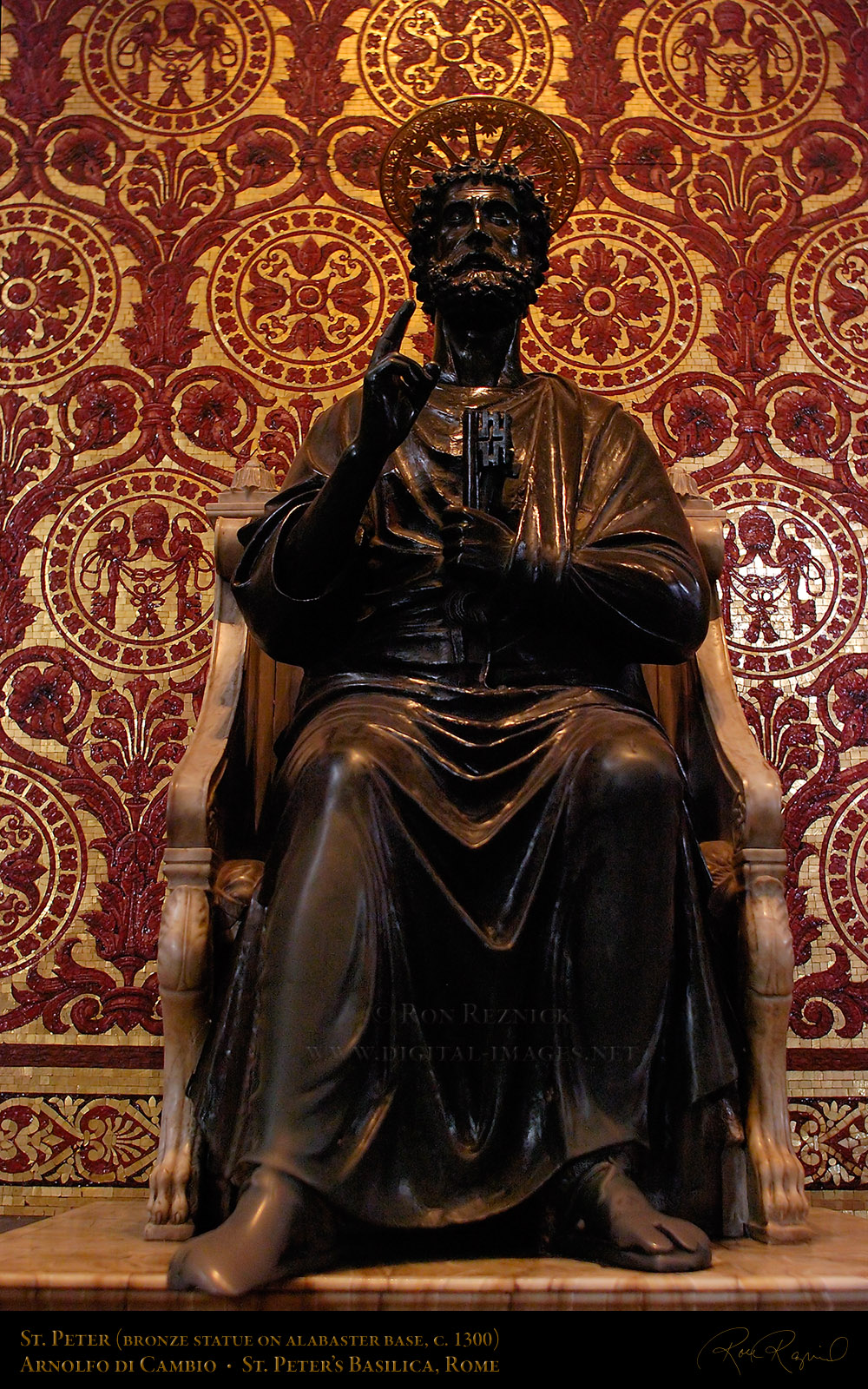


St. Peter statue in the church

The St Peter Statue in St Peter and Paul church resembles the one in the St Peter's Basilica in Rome.

It was designed by the artist Arnolfo di Cambio’s sculpture of St. Peter, c. 1300.  this highly venerated sculpture of St. Peter is seated on an alabaster throne. His right foot protrudes from the base.

In flowing robes, he pictured holding the keys to heaven.

The statue has long been regarded as having been created in the 5th century, commissioned by Pope Leo I (440-461).

Interestingly, except with the halo, St Peter which has the unique feature of has curly beard and hair and the statue in St Peter and Paul Singapore clearly draws from the one in Rome and attributed to the artist Arnolfo.

Also its historicity dates back much longer as it was commissioned by Pope LeoI in the 5th Century.
A comparison of the statue found in Singapore and Rome is found below.

http://www.digital-images.net/Gallery/Scenic/Rome/Churches/StPeters_Int/stpeters_int.html

http://blog.omy.sg/jerome/2013/05/24/the-chinese-church-%E2%80%93-another-national-monument-in-need/
The statue of St. Peter at the entrance.


StPeter_7655M

Monday, April 20, 2015

Father Emile Joseph Mariette of St Peter and Paul Church who also went on to build St Theresa church


Reverend Father Emile Joseph Mariette was Vicar of Church of Saints Peter and Paul from 1908 to 1928. His contribution did not end there.


The MEP father did not stop there. Later he set about building St Theresa built the church of St Theresa in 1923. The church was established in 1929.

Indeed the St Peter and Paul influence amongst early churches was profound.


Portrait of Reverend Father Emile Joseph Mariette, Vicar of Church of Saints Peter and Paul

Chan Teck Hee who was also one of the important donors of St Peter and Paul assisted in donating 5 more bronze bells to Father's Emile Joseph mission at the new church. He named it after his five children, and will string a chord when rung.


This MEP father was an example of the MEP priests in Singapore who took the efforts to learn the dialects which included Hokkien and Teochew languages. This enabled them to communicate and catechize to the parishioners and their family members as well as early community.


He also officiated in the pontifical High Mass for the first local born priest Michael Seet in 1911.


http://eresources.nlb.gov.sg/infopedia/articles/SIP_1704_2010-08-16.html

http://eresources.nlb.gov.sg/printheritage/image.aspx?id=c8a952cb-b2a4-4d5d-b239-b2fb41f68ac8

http://eresources.nlb.gov.sg/newspapers/Digitised/Article/straitstimes19280314.2.41.aspx
http://www.sfxms.org.sg/articles_barthoulot.html


The first local born Priest in St Peter and Paul and the first founding fathers of St Peter and Paul

Father Michael Seet had the honour to be the first local priest in Singapore and he was the first local born priest to serve in St Peter and Paul church.

He was ordained in 1911 when Singapore had no seminary yet.

In those days, the seminary was in college general in Penang as the MEPs developed a base there for missionary works in this region. The seminary was run by the MEPs.

Father Michael Seet had studied there for 12 years. He was ordained by Bishop Emile Barrilon and concelebrated by Rev Fathers Emile Joseph Mariette(Master of Ceremony) , Father Duvelle, and Father G. Chevauche(all MEP Fathers).

In 1911, Bishop Barillon was overseer in Malacca and Singapore. Father G Chevauche was the first to erect the first church, a plank chapel, in Kampar, and an outstation of mother church St Joseph in Penang under Barillon, Bishop of Malacca. It was blessed and officiated by Bishop Barillon.

The other priest that later were locally born and ordained were Stephen Lee and Rudolf de Souza in 1922.

Notably Father Michael Seet, was the second son of cathechist Seet Twa Tee. He had been a cathechist for 30 years. He lived in the house next to the church, and these houses had been erected after Chan Teck Hee, the famous donor to the church, director of Sze Tong Hai bank and Kiam Hoa Heng Co Bangkok, purchased the plot and build hoses for the Cathechists, the widows and the aged.

In 1911, the year Father Michael Seet was ordained, there were indeed 5 parishes only, namely, the Cathedral of Good shepherd, St Peter and Paul, Our Lady of Lourdes, and St Joseph Church(Bukit Timah) with priests linked to the MEP with the fifth from St Joseph church(Of which St Joseph church belonged to Portugese mission) and Catholics numbered

The first founding Fathers of St Peter and Paul were Father Issaly and Father Pierre Paris.

Father Michael Seet died at the age of 63 on 18 June 1946, and was buried at Bidadari Cemetary.

http://eresources.nlb.gov.sg/newspapers/Digitised/Article/straitstimes19280314.2.41.aspx
http://www.penangdiocese.org/wp-content/uploads/2012/09/spSHJ.pdf
http://eresources.nlb.gov.sg/newspapers/Digitised/Article/singfreepressb19300910.2.47.aspx


Sunday, April 19, 2015

The stained glass in the middle of the church

Interestingly , St Peter and Paul also has a stained glass right in the middle of the church depicting Our Lady of Lourdes. Yes whilst in the publication of the book for the Lady of Lourdes there is but one Lady, the devotion evidently during the second half of 1850s to this special Lady, came from St Bernadette of Lourdes where our Lady appeared. Indeed it was on 11 Feb 1858 that our Lady of Lourdes appeared to St Bernadette revealing herself as the Immaculate Conception, ie that Mary was born without original defilement or sin; She was truly immaculate. To prove this. miracles took place at Lourdes. A spring of water where she appeared flowed and till this day many pilgrims are healed. It is a place of refuge and comfort and healing, spiritually and physically. This coincides very strongly that perhaps to cater to this very strong devotion our Lady of Lourdes in Ophir Road Singapore was built in 1888 shortly after St Peter and Paul in 1870. It is also because this fact that is why the stained glass in St Peter and Paul right in the middle with prominence was given our Lady of Lourdes. Coupled with this is the strong rosary devotion, undergirded by efforts of Rosary pope Leo XIII which saw the unearthing of broken rosaries under the Cathedral of Good shepherd built in the 1850s. In this another unbroken rhythm of the Catholic Church life in Singapore, our Lady of Lourdes is still celebrated till this day in the Indoor Stadium. On 6 Dec 2014, the Lourdes Experience was held in Singapore for the third time preceding one law being held in 2004 and 2008. It commemorated the 160th anniversary of the dogma of the Immaculate Conception, and the 150th anniversary of the appearance of Our Lady of Lourdes to St Bernadette, conforming church teachings and being a source of joy, comfort and healing to many infirmed. It is remarkable that St Peter and Paul has a stained glass in honour of our Lady when it was built in 1870, which led to Lady of Lourdes church in 1888 and even St Bernadette church in Singapore at Zion Road built in 1958 in what can also be seen as another unbroken rhythm that is linked from early Singapore church history to present day and the blessings of Our Lady. Lennard at 1:43 PM

Friday, April 17, 2015

Some important historical people St Laurent Imbert and Father Beurel and Father Becheras MEPs leading to St Peter and Paul

St Laurent Imbert was born 1796. The MEP order started in The starting point of missionary began in Siam during 1658. Based there, the Siamese King supported the seminary of St Joseph. It was revitalized by Napolean in 1805 but due top a dissent with the Pope, and again under LouisXVII in 1815. In 1839, St Laurent Imbert became Apostolic Vicar of Korea. However as Russian war ships came and demanded trading rights and residency from Korea , the latter allied with French and brought forth French MEP priests like St Imbert. Finally they were massacred for their faith. His travels took him to Malaya Peninsula. St Laurent Imbert came to Singapore in 1821 before proceeding to Korea. He was the first to be martyred along with 3 others in Korea in 1839 for the faith. Later the oldest church in Singapore was named The good Shepherd, as they remembered him as "the good shepherd lays his life for his flock". In 1984 Pope John Paul the 2nd canonized him and 103 other martyrs. The second oldest church St Peter and Paul arose from the efforts of the same missionary house that St Laurent Imbert came from. Instrumentally helped in big way by Father Beurel, who also an MEP priest, who built the SJI and CHIJ (1st Catholic schools in Singapore) and thereafter, helping to build the Cathedral of Good Shepherd and St Peter and Paul church. His era which marked the first phase of MEP activity in Singapore, came to an end around in 1872 when he died. Leaving us in good shape. Instrumentally, he brought in only 6 sisters and 4 brothers(one sister died on the ship) and that spread the missionary zeal in Singapore. He was also known as founding Father of Catholicism in Singapore, due to his untiring efforts. He also helped build the mother church and the first three churches Church of St. Peter and Paul along Queen Street, the Church of St. Joseph in Bukit Timah and the Church of the Nativity of the Blessed Virgin Mary in Upper Serangoon Road. From the period of 1872 onwards just after St Peter and Paul was built in 1870, leaving good institutions and momentum in its wake, Father Becheras continued to soldier on. After he became parish priest of St Peter and Paul. As Vicar General of church in Serangoon, he continued to develop the northen side of Singapore in Serangoon area and Hougang restarting Holy innocent school and initiating bilingualism and serving the church. He died in 1957. http://www.patheos.com/blogs/mcnamarasblog/2009/09/st-laurent-marie-joseph-imbert-1796-1839.html http://eresources.nlb.gov.sg/infopedia/articles/SIP_1548_2009-07-27.html http://eresources.nlb.gov.sg/newspapers/Digitised/Article/singfreepressb19340406.2.20.aspx http://eresources.nlb.gov.sg/newspapers/Digitised/Article/freepress19571008-1.2.108.aspx http://catholicnews.sg/index.php?option=com_content&view=article&id=1849

Thursday, April 16, 2015

Some notable Donors' name seen the Stain Glass

Adorning the church are stain walls, where two notable donors name can be found: Low Kok Chiang, and Chan Teck Hee. They were childhood friends. In 1872, Low established his company along Chao Phraya river: Kiam Hoa Heng. It had particular patronage from the Thai King Chulanglongkorn as He took his childhood friend Chan Teck Hee into his import and export business. Chan was also director of Sze Hai Tong Bank established in 1907. He was part of prominent early Teochews who traded extensively, and notably rice in China, Thailand and Singapore. Together the pair, donated much to St Peter and Paul. Their names can also be found in Sacred Heart. As well as Nativity Church. Chan became leading member in the Catholic community and bought land adjoining St Peter and Paul Church in 1897.He build 11 houses known as St Joseph Houses for cathechists, widows and the aged. Then St Peter and Paul was known as the Queen street church. When it was due for expansion, he together with his childhood friend Low Teck Chiang donated generously to build a new church in Tank Road. http://en.wikipedia.org/wiki/Low_Kiok_Chiang http://eresources.nlb.gov.sg/infopedia/articles/SIP_280_2004-12-15.html http://eresources.nlb.gov.sg/history/events/95dd2332-7d1c-459c-a833-07499535872a http://eresources.nlb.gov.sg/newspapers/Digitised/Article/singfreepressb19300910.2.47.aspx

Father Becheras, a model MEP who served St Peter and Paul and promoted bilingualism

Father Becheras was a prominent Catholic Priest featured in many old photographs. He had been instrumental in St Peter and Paul. He served since 1899 at St Peter and Paul. He was recalled to France after 15 years work in the region, in 1914 and returned in 1919. His role as Vicar in Serangoon Village after returning from France in 1919. He raised more than $100,000 to extend the Catholic school and the Church. He is also director of Holy Innocents school. Upon his arrival, he also restarted the Holy Innocents English school in Upper Serangoon in 1916 with a class size of 30 students. Today It is known as Monfort Secondary. He is a true shepherd in the sense too that he took care of his parishoners. Word has it that he would go around with a cane looking for "lost sheep" in Getai and bringing them back. (Getai is a popular community get together event, with drinking and sit down dinner normally on open grass field, hosted during important Chinese festivals like the 7th Month Hungry Ghost festival where singers would perform on stage and including auctions for items for charity and donations to temples) After falling down on a bicycle in 1929, he walks with a slight gait. He also founded Catholic High School in 1935 and prominent alumni include our Prime Minister Lee Hsien Loong. He supported education as Catholic High School taught bilingualism in Singapore, an influence of MEP carrying till to Modern Singapore. A former Parishoner writes of his Father as this of Father Becheras: "My father was educated in Chinese then but in Catholic he was also taught English. Most Chinese-speaking parents then usually wanted their children to be educated in Chinese for their cultural identity.Catholic High School was founded in 1935 by Rev. Fr. Edward Becheras, a French missionary. Although it is a Catholic school, it also accepts non-Catholic students like my father. Thanks to Rev. Fr. Edward Becheras, my father was educated in both Chinese and English. Becheras envisioned the school of bilingual learning." https://timesofmylife.wordpress.com/2008/07/14/my-fathers-time/ http://eresources.nlb.gov.sg/newspapers/Digitised/Article/singfreepressb19340406.2.20.aspx

Wednesday, April 15, 2015

Early Benefactors to St Peter and Paul

One of the early designs of the church are donated to the early benefactors. One such name was Low Kok Chiang. He is a prominent giver and features in St Peter and Paul. His company was Kiam Hoa Heng. This could explain the Thai influence of lotus in the church. He was a philantrophist, giving much to the church. Initially he had donated to St Joseph Institute, the first Catholic boys School. Later he assisted to build the St Peter and Paul church. Hi last contribution was to sacred heart, one year before he died. The architecture which features many lotus is a sign of Thai influence(previously Thailand was known as Siam)s could explain the reminiscent Thai architecture of the church in a mixture with French Gothic design. Mr Low donated three large stained glass to St Peter and Paul. Evidently the important feature is the central stin glass which is Our Lady of Lourdes, to the right and left are St Peter and St Paul. The other benefactor is Chan Teck Hee. He built eleven houses on the adjoining site of St Peter and Paul in 1897 and donated it to the aged, the widows and the cathechists. His name is also featured on the stained glasses in St Peter and Paul. http://eresources.nlb.gov.sg/newspapers/Digitised/Article/singfreepressb19300910.2.47.aspx http://en.wikipedia.org/wiki/Low_Kiok_Chiang https://thelongnwindingroad.wordpress.com/tag/church-of-sts-peter-and-paul-building-fund/

Church St Peter and Paul origins

For the early origins of St Peter and Paul, we neeed to look at the facade and architecture. Notably on the bells installed by Father Pierre Paris, are the lady of Lourdes and the Sacred Heart. This traces the history back to before the 1870s at the time just before its construction. The devotion of our Lady of Lourdes was in 1858 when St Bernadette saw apparations of the Virgin Mary in Lourdes France. The other engraving on the historical bell is when the Sacred Heart was imprinted on it. This shows the strong devotion to the Sacred Heart, spread by Mary Alacoques. She was a French Nun who lived from 1647 to 1690. Sacred heart devotions were spread by the Jesuits, 75 years later and arrived at Singapore shores with the evidence of strong devotion shown on the bell. http://en.wikipedia.org/wiki/Church_of_Saints_Peter_and_Paul,_Singapore#History_and_architecture